

David Bordwell's website on cinema   click for CV
    %62or%64%77e%6cl%40%77%69%73c%2e%65%64%75

Home

Blog

Books

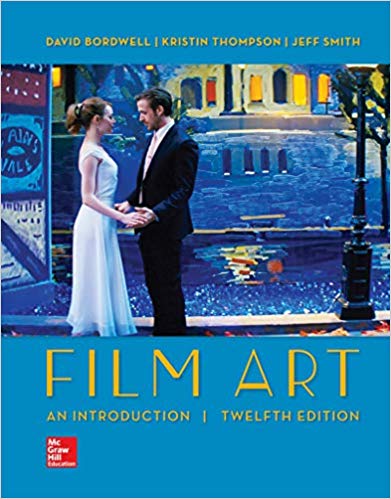
Film Art: An Introduction

The Way Hollywood Tells It pdf online

Poetics of Cinema pdf online

Figures Traced In Light

Ozu and the Poetics of Cinema pdf online

Exporting Entertainment : America in the World Film Market 1907–1934 pdf online

Essays

Nordisk and the Tableau Aesthetic new

William Cameron Menzies: One Forceful, Impressive Idea

Another Shaw Production: Anamorphic Adventures in Hong Kong

Paolo Gioli’s Vertical Cinema

(Re)Discovering Charles Dekeukeleire

Doing Film History

The Hook: Scene Transitions in Classical Cinema

Anatomy of the Action Picture

Hearing Voices

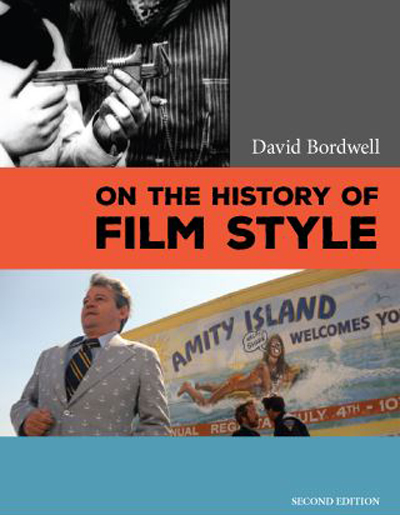
Preface, Croatian edition, On the History of Film Style

Slavoj Žižek: Say Anything

Film and the Historical Return

Studying Cinema

Articles

Book Reports

Observations on film art

Is there a blog in this class? 2010

Thursday | September 2, 2010

Kristin here:

Update: Back in the spring we announced that the University of Chicago Press will be publishing a collection of our blog entries. Now that volume is in press and has a title: Minding Movies: Observations on the Art, Craft, and Business of Filmmaking. We’re due to see page proofs soon, and the plan is for the book to appear in April.

Every now and then our editors at McGraw-Hill, the publisher of Film Art: An Introduction, pass along some interesting feedback from users of the textbook. Recently we learned that a professor started using Film Art as a result of reading our blog. One person mentioned having the students follow the blog’s current offerings during the semester. Some recommend specific entries to their classes. Still others use the information we supply in creating their lectures. A few say they don’t incorporate the blog into their courses but would like to start doing so. That’s all good news to us. Although “Observations on Film Art” aims at a general readership, we also hope that our writings about the art, the industry, and the technology of cinema provide a resource for teachers in high schools, colleges, and universities.

Now it’s that time of year again, when professors polish up their syllabi for the beginning of a new semester. It has been a year since the last version of our series “Is there a blog in this class?” appeared. Here we offer some suggestions as to how the entries of the past twelve months might be useful in teaching. And for those of you general readers who have just discovered the blog, the following could serve as a handy guide in exploring more of its riches. Past entries can be found here, here, and here.It’s a huge site by now, though. This is our 356th entry! We’ve recently added a lot of categories to the menu on the right-hand column, but a lot of entries don’t fit neatly into a single category. So, as usual, I’ll go through chapter by chapter and point out entries from the past year that might be relevant.

Chapter 1 Film as Art: Creativity, Technology, and Business

Nearly everybody over 20 complains about Hollywood’s summer blockbusters with their multi-hundred-million-dollar budgets. But should they? Patriotic filmgoers might be surprised to learn that few products do so much good for our country’s lackluster balance of trade. See “Don’t knock the blockbusters.”

The release of Godard’s challenging Film socialisme on the festival circuit gave us an occasion to discuss the variety of venues in which different sorts of films are exhibited in “It takes all kinds.”

Chapter 2 The Significance of Film Form

This is the chapter where we talk about the kinds of meaning that we can attribute to films, including symbolic meanings. Whether you want to encourage or discourage your students from hunting for them in films, “Between you, me, and the bedpost” offers one take on the subject. Warning: it’s risqué—though in this day and age, only slightly.

It’s not an entry for beginning students, but grad students might be interested in “Now you see it, now you can’t.” It’s a report on how scholars are studying the ways in which we perceive movies and react to them emotionally.

Chapter 3 Narrative as a Formal System

Watching a movie, page by page” examines the novels The Girl with the Dragon Tattoo and The Ghost Writer to see whether the “acts” (or large-scale parts) of films can be found in the literary version. Of interest for teaching large-scale segmentation or if your course has a unit on adaptations.

No coincidence, no story.” The title pretty much tells it all. Coincidences supposedly have no place in tight storytelling, and yet there are more of them in films than one might think. How do filmmakers get away with them?

Even as summer ends, discussion and disputation concerning Inception is still all over the internet. Our own entry on the subject was “Inception: Dream a Little Dream within a Dream with Me.” We didn’t try to do a neat, unified essay on the film, so it doesn’t fit well with Film Art’s Chapter 11, our collection of film analyses. But we discuss topics that relate to this chapter: exposition, motivation, and embedded plotlines. We wrote a follow-up, “Revisiting Inception,” commenting on what Christopher Nolan had said about the film in interviews. This entry also compares Inception’s narrative strategies with those informing Memento and The Prestige; the latter film receives several pages of analysis in the ninth edition of Film Art.

Chapter 4 The Shot: Mise-en-Scene

We don’t often get a chance to write about set design, but art director William Cameron Menzies didn’t just design sets. He designed shots. He especially liked to create environments that almost forced the director to stage in depth. (This entry is also pertinent to the deep-focus section of Chapter 5.) See “Foreground, background, playground,” which is a teaser for a longer essay, “William Cameron Menzies: One Forceful, Impressive, Idea.”

Every now and then an actor who has provided the motion capture for a digital film character is praised highly and mentioned as a possible candidate for an Oscar nomination. But where do the actor’s performance leave off and the special effects begins? We consider the question in “Motion-capturing an Oscar.”

We often find Film Art users saying they want more on acting. Our entry “The Cross” is about a kind of staging which seems to have been forgotten in this era of rapid cutting and close framing. This analysis provides a way of studying acting, since staging is one important component of performance.

Speaking of staging, we have long urged people to study the resourceful blocking of actors in the supposedly “boringly theatrical” films of the 1910s. “Nordisk and the Tableau Aesthetic” argues that the great Danish studio of the period harbored several directors who made subtle use of staging within the single fixed shot.

Master cinematographer Steven Box (Donnie Darko) lectured in Madison, and we blogged on his discussion of various aspects of film lighting, many of which tie in beautifully with what we say on the subject in Film Art. See “Light is a law.”

Chapter 5 The Shot: Cinematography

Looking for a way to get students interested in the long take? Maybe show them the films discussed in “2-4-6-8, whose lipdub do we appreciate?” Not only are they amazing pieces of amateur filmmaking by high-school kids, but they actually fit into a proud old tradition of cinematic technique.

Most feature films nowadays are wide-screen productions, and it’s useful to consider how compositions can be handled in the wide format. Some possibilities are discussed in the second half of the web essay, “Another Shaw Production: Anamorphic Adventures in Hong Kong.”

Chapter 6 The Relation of Shot to Shot: Editing

Seed-beds of style” takes a close look at a technique called “axial cutting,” that is, editing that moves straight to a closer view—and often to a third, even closer one—without a shift of camera angle. The survey covers the history of the cinema and reveals that a technique that started in the 1910s is used a lot for The Simpsons. This entry also makes some pedagogical points about teaching a course on the history of film style.

Chapter 7 Sound in the Cinema

Film is a visual art, so filmmakers should try to make the images carry the story, right? Not necessarily. Lengthy monologues can be cinematic, too, as we argue in “Tell, don’t show.” This entry could be used for studying dialogue, but it provides some good examples of sustained acting as well. Moreover, although the scenes involved aren’t long takes, they provide good examples of very slow editing rhythms.

Chapter 8 Summary: Style as a Formal System

Interesting style is where you find it. In “Daisies in the crevices,” we take the occasion of Turner Classic Movies’ screening a bunch of restored Columbia low-budget films of the 1930s to reveal some unexpectedly sophisticated stylistic touches.

The Akira Kurosawa centenary has come and gone, but it has left nearly all of his films available on DVD. In “Kurosawa’s Early Spring,” we talk about some distinctive traits of his early style. Handy for teaching style in general or as an example of an auteur’s characteristic traits.

We’ve run across some teachers who make comparisons between graphic novels and movies in their classes. If you’re one of them, have a look at “Tintinopolis,” an analysis of the cinema-like style of Hergé.

Chapter 9 Film Genres

Several of the entries already mentioned comment on genre conventions. The most extended discussion involves romantic comedy but touches on melodrama too (“No coincidence, no story“).

Chapter 10 Documentary, Experimental, and Animated Films

Sticky splices and hairy palms” does double duty. We talk about the stylistic traits of experimental films that offer challenges to archival restoration and also about some worthy but little-known films from the Los Angeles avant-garde of the 1960s and 1970s.

Animated features are becoming ever more popular, given their financial success and broad appeal. 2009 was a particularly good year for such films, and we survey the best in “The other expanded Oscar category.”

Chapter 11 Film Criticism: Sample Analyses

The last year has seen a lot of teeth-gnashing about the supposed decline of serious film criticism caused by the internet. We have weighed in on this controversial topic in “Film criticism: Always declining, never quite falling” and “Glancing backward, mostly at critics.”

Chapter 12 Film Art and Film History

Historically, film styles have influenced much later filmmakers. Two of the movements we discuss in this chapter, German Expressionism and French Impressionism, have had a big impact of the style of one of the New Hollywood directors, Martin Scorsese. We demonstrate how in “Scorsese, ‘pressionist.”

Speaking of German Expressionism, the new, nearly complete version of Metropolis gave us an opportunity discuss how the latest restored footage affects this familiar classic, “Metropolis unbound.” We also examine an old warhorse and point out what’s interesting about it in “Der Golem: Revisiting a classic.”

Looking for good silent films that might actually convince your students that old films are worth watching? Every year we avoid posting a 10-best list of current films and instead concoct one for the year ninety years before. Our latest is “The best ten-plus films of …1919.” Most of this batch are available on DVD.

Some of the greatest silent filmmakers have recently been given the royal treatment on DVD. For information on new discs of Méliès, Lubitsch, and Vertov films, see “DVDs for these long winter evenings.” More recently, Von Sternberg got similar attention, as related in “Never too late silents.”

General

Teachers who use DVD commentaries in class or in preparing lectures may waste time sorting out the good from the bad. In “I am not Carl Dreyer, and I should shut up,” we recommend a particularly good one: director Guillermo del Toro (Pan’s Labyrinth, Hellboy) talking cogently about Carl Dreyer’s great horror film, Vampyr. He has some things to say that fit in well with Film Art’s analytical approach, such as “It is foolish to try to decode the symbols in Vampyr. It is important to understand the rhythm and the repetition of them.”

DVD making-of supplements can provide excellent teaching tools. On the other hand, those supplements can be mostly mutual praise-fests for the people involved in the film. Every now and then we write about the ones that seem solidly useful, the latest entry being “Beyond praise 3: yet more DVDs that really tell you something.” (We don’t include commentary tracks or we would be spending our entire lives on these entries.) We also warn about a few supplements that aren’t worth checking out.

Have a great school year!

No coincidence, no story

Thursday | August 26, 2010

Serendipity.

DB here:

I’ve been thinking about coincidences lately. Watching Hong Kong movies can do that to you.

Hong Kong vs. Hollywood?

Initial D; I Corrupt All Cops.

In Initial D (2005, Andrew Lau Wai-keung and Alan Mak Siu-fai, script by Felix Chong Man-keung), the protagonist Takumi is dazedly in love with the seductive schoolgirl Natsuki. Takumi’s pal Itsuki is out with another girl when he spots Natsuki riding out of a “love hotel” with an older man. Itsuki tells his pal. This leads to a major crisis, in which Takumi’s faith in Natsuki is shaken.

Then there’s I Corrupt All Cops (2009) from the indefatigable writer-director-producer-actor Wong Jing. (Many wish he were far more fatigable.) Unicorn, a corrupt, brutal police officer, has just been savagely beaten by gamblers who once were his allies. He staggers to a street stall and nearly collapses, spitting blood into his congee. Then he glimpses his girlfriend getting out of a rich man’s car. In the next scene, when he visits her apartment, he finds his boss, the even more corrupt cop Lak, in her bed. His realization that he can trust no one pushes him to join the police anti-corruption unit.

True, the coincidences play different roles in the two movies. In Initial D, there might be an innocent explanation for Natsuki’s visit to the hotel. Perhaps Takumi’s friend even mistook another girl for her. So we may be inclined to suspend our judgment and wait for more information about whether she’s actually being unfaithful. In I Corrupt All Cops, Unicorn’s suspicions about his girlfriend’s disloyalty are immediately confirmed; instead of suspense, we get surprise, in the form of the revelation of who her lover is.

But in each case, a major plot movement is triggered by sheer accident. Itsuki wasn’t spying on Natsugi’s assignation; he was trying to talk his date into the love hotel. Unicorn wasn’t suspicious of his girlfriend, he just happened to be across the street when she came home. Each coincidence is also a matter of timing: Had either man come a few minutes later to the location, he wouldn’t have learned the big secret. In retrospect, we are likely to think that the screenplays of Inital D and I Corrupt All Cops are using chance rather than causality to move their action forward.

Granted, Hong Kong films are generally weak in plot construction. Even the lauded films of Wong Kar-wai are built out of casual encounters and unpredictable turns of events. The old Chinese maxim “No coincidence, no story” might seem to give accidental revelations a high place in this cinema. But Hong Kong films aren’t outstanding offenders. When you start to look, you find that films in different traditions are no less committed to coincidence. After all, Rick in Casablanca notices the vast implausibility of what’s just happened: “Of all the gin joints in all the towns in all the world, she walks into mine.”

One precept of Hollywood screenwriting has been that coincidences are permissible when you’re setting up the narrative. Indeed, they’re often necessary: Circumstances have to come together in some way to launch an extended action. A sudden rainstom brings boy and girl together under the same awning, creating the cute meet, and things can build from there.

But, the Hollywood wisdom goes, don’t use a coincidence to develop or resolve the plot. Consider another Hong Kong film, Infernal Affairs (2006, directed by Lau and Mak, with script by Chong). Chan the undercover cop has come in from the cold. While Internal Affairs officer Lau is out of his office, Chan is poking idly around Lau’s desk. There he finds the envelope on which Chan himself once scribbled a correction.

That envelope was in the hands of the gang that Chan joined. If Lau has that envelope, he must be the triad mole in the police force. This recognition triggers the film’s climax: Chan flees police headquarters and sets out to unmask Lau’s treachery.

You would think that if Hollywood filmmakers were anxious to avoid such a timely accident, the Infernal Affairs remake known as The Departed (directed by Martin Scorsese, script by William Monahan) would find another way for Billy Costigan to discover that Colin Sullivan is the mole. But no. Billy notices the telltale envelope sticking out from a pile of papers on Sullivan’s desk.

The different ways the two films drive the discovery home to the audience merit a closer look than I can spare here. My point is that the handy coincidence of the police mole leaving this damning clue for his adversary to find is used without apology in the Hollywood movie. And like its counterpart, the scene sets off the movie’s climax. You could even argue that Infernal Affairs supports its revelation a little better. Billy accidentally glimpses the crucial envelope, but Chan is actively browsing Lau’s desk, perhaps because after years spent among triads he doesn’t trust anyone .

So you have to wonder. Maybe filmmakers in many traditions have accepted the Chinese maxim. Moreover, contrivance of this sort doesn’t seem to damage a film’s reputation. (Many critics considered The Departed one of the very best US films of 2006.) More generally, we seldom feel such coincidences to be arbitrary or forced. Maybe screenwriters and directors have found ways to mask the coincidental tenor of such scenes.

As with our earlier Inception entry, we’re in the realm of motivation.

The roots of coincidence

Most story actions result from characters’ choices, purposes, reactions, plans, and the like. These factors create patterns of cause and effect. Chan/Billy didn’t just mosey into Lau/ Colin’s office: He came in because he thought it was safe to break his cover. We accordingly worry for him because we know, as he doesn’t, that he’s far from safe.

Everyone seems agreed that a plot can’t replace all causal connections with a string of coincidences. If everything happens by convenient accident, then we can’t form any expectations about what will happen next. And without expectations, our cognitive and emotional engagement with the story is likely to be slight. Moreover, designing a story packed with coincidences isn’t that hard. Children do it all the time. But most artistic traditions thrive on their constraints. If anything at all can happen to advance or conclude your plot, you’re playing tennis without a net. The interesting challenge for a storyteller in traditional forms is to create a pattern of incidents that arouses our curiosity, builds up suspense, and presents surprises that turn out to be, in retrospect, cunningly prepared for—all the while playing on our emotions.

Yet, and again: No coincidence, no story. Sometimes, the plot’s forward momentum needs encounters and discoveries not planned by the characters. So how can these convenient accidents be made to serve narrative craft?

Well, what is a coincidence anyway? At the least, it’s a matter of converging incidents, as the name implies; but surely it involves more.

I wake up one morning and ask, “I wonder what my sisters are up to? I haven’t heard from them in a while.” Nothing important is happening in the family, no health crises or upcoming reunions. I just wonder how the girls are. So I reach for the phone, but before I can dial I get a call from Diane (the Texas sister). I say, “What a coincidence! I was just going to call you.”

This sort of thing happens. But not all the time. Not even most of the time. The thousands of things that flit through our day almost never match up so nicely. And we don’t notice it when they don’t match up, because we don’t expect them to. The non-coincidences of everyday life go unregistered because they’re so pervasive.

On those rare occasions when things do sync up, we notice. In The Evolution of God, Robert Wright puts it well:

It makes sense that human brains would naturally seize on strange, surprising things, since the predictable things have already been absorbed into the expectations that guide them through the world; news of the strange and surprising may signal that some amendment of our expectations is warranted.

We usually attribute such coincidences to chance. But humans aren’t very good at thinking about chance. If the coincidence seems meaningful, as many do, we’re always tempted to consider it the result of some secret force. Did I send out invisible thought-waves that Diane somehow picked up? Did fate, or God, make her call me? In general, when we notice patterns, we look for causes. The phone-call convergence is a pretty minimal pattern, but even there we might be tempted to find a cause.

I hang up on Diane and the phone rings immediately. It’s Darlene (the peripatetic sister). “I was just trying to call you, David, but the line was busy.” This is getting weird. The pattern heightens and may prompt a stronger impulse to search for causes. Do we three siblings mind-meld in some mysterious fashion? (If so, though, why do we need phones?) It’s just a coincidence, highly improbable but, out of all the times we three think about one another and make phone calls, not impossible.

I believe that narrative artists in all media are practical psychologists. They trigger and exploit and heighten our ordinary ways of making sense of the world. Philosophers and statisticians have sophisticated ways of thinking about chance, but they needed special training to get beyond our folk psychology. Artists take us as we are.

Stories can use coincidences because we accept them. They are the sorts of things that sometimes happen, and so, as Aristotle argued, they are fit subjects for plot-making.

The poet’s task is to speak not of events which have occurred, but of the kind of events which could occur, and are possible by the standards of probability or necessity (Poetics, Chapter 9).

Here Aristotle points to two sorts of possible events. There are events that we expect to happen as a necessary result of earlier events; this corresponds to some notion of causality. Then there are events that are merely probable—things that are likely to happen.

But how likely is my call from Diane and the followup from Darlene? Aren’t these examples of what Aristotle dismisses as “the arbitrary and fortuitous”? Not necessarily, because for Aristotle too the storyteller is a practical psychologist. Things that seem unlikely, he says, can be motivated by reference to people’s beliefs or to the fact that improbable things are likely to happen occasionally.

Irrationalities should be referred to “what people say,” or shown not to be irrational (since it is likely that some things should occur contrary to likelihood) (Poetics, Chapter 25).

In sum, how do you motivate a coincidence? Aristotle recommends two tactics, which I could use if I were writing a story featuring the felicitous phone calls. People say that members of a family have a special affinity that can cross time and space. And anyhow, stranger things have happened.

Narrative norms

SPL.

Aristotle suggests a third motivational tactic as well. He says that unlikely things may be resolved “by reference to the requirements of poetry.” Poetry here refers to any verbal artform, just as poet refers to the maker of literary works in general. So what are the “requirements” of storytelling?

Most minimally, a plot needs an inciting incident. If I were a fictional character, my lucky phone calls might kick off a plot in which my sisters and I, feeling a new and mysterious bond, set out on road trips to meet somewhere. The telephone contrivance would correspond to the Hollywood dictum that coincidences are permissible at the outset of the plot.

Many commentators on Aristotle take his mention of poetic “requirements” to involve more specific conventions, especially those of different genres. We’ve long known that certain kinds of art works permit things that would be forbidden in other kinds. A children’s movie is unlikely to show chainsaw dismemberings, unless Eli Roth has been given a producing deal at Pixar. This idea of genre fitness or decorum has implications for coincidences too.

Clearly, coincidences flourish in comedy. The innocent young man trapped in a lady’s boudoir will have to hide under the bed because her husband bursts in at an awkward moment. In the long chase sequence through old Hong Kong in Project A (1983), Jackie Chan keeps bumping into his superior officer. Sometimes Jackie is set back by the encounter, but once the officer inadvertently rescues him. David Lodge writes: “Audiences of comedy will accept an improbable coincidence for the sake of the fun it generates.” His novel Small World culminates in a pile-up of coincidences in which an airline check-in clerk happens to give the heroine a copy of The Faerie Queene at the precise moment she needs to check a literary reference.

This is all highly implausible, but it seemed to me that by this stage of the novel it was almost a case of the more coincidences the merrier, provided they did not defy common sense, and the idea of someone wanting information about a classic Renaissance poem getting it from an airline Information desk was so piquant that the audience would be ready to suspend their disbelief.

Melodrama is another genre that relies on coincidences, particularly those that bring bad luck. (Think of Rock Hudson’s cliff-edge fall in All that Heaven Allows.) Likewise, I think that the revelations of the incriminating envelopes in Infernal Affairs and The Departed are partly motivated by genre conventions. In undercover tales, the detectives have to be alert for any physical items that might betray them or offer clues. So the envelopes are something that the hypersensitive narc could plausibly fasten onto. (Why the envelopes are left lying around in the first place is another part of the story, which I’ll come to.) Similarly, Initial D is partly a teenage romance, and we know that such films require an obstacle to happiness; that’s what Itsuki’s accidental discovery provides.

There’s another “requirement” of poetic art that can motivate coincidence, and it cuts across different genres. In Wilson Yip Wai-sun’s SPL (2005), a brutal martial-arts fight in a nightclub ends with the gangland chief Wong Po hurling Inspector Ma through a window far above the street.

Down below in a waiting car are Wong Po’s wife and baby son, the only things in life he loves.

Care to have a guess where Ma lands?

This is a coincidence motivated by poetic justice: The brutal Wong Po has inadvertently killed his wife and child. Serves him right!

As we might expect, Aristotle anticipated poetic justice too. He remarked that there was a special sense of fitness when the statue of a murdered man toppled over on his killer.

Three dimensions of narrative

Casablanca.

In an essay in Poetics of Cinema I argued that we can think of any narrative as having three dimensions: the story world, the macrostructure of the plot, and the narration–the flow of information as it’s presented, moment by moment, in the film. Each of these dimensions can motivate coincidence, and each answers to what Aristotle calls “requirements” specific to narrative art.

Say you want two characters to meet without making a rendezvous. One way is to establish that each has a routine. Jack stops for coffee at Starbuck’s every morning on the way to work; so does Jill. Sooner or later, it’s plausible that they will run into each other. The appeal to routine is probably behind the unlucky coincidence in I Corrupt All Cops. After being beaten, Unicorn staggers to the food stall across from his girlfriend’s apartment house–evidently on his way to call on her.

Another sort of story-world motivation involves characterization. In Initial D, it’s not implausible that the randy Itsuki would be hanging around outside a love hotel. Given his personality, he’s more likely to see Takumi there than other, more upright characters would be. In Infernal Affairs, Lau is a cautious mole, but he has no reason to hide the telltale dossier because he thinks it would be meaningless to anyone else. (Lau can’t know that Chan is the one who scribbled the corrected spelling on the envelope.) Lau’s studied nonchalance lets him stack papers on his desk without concern that this one is particularly revelatory.

Coincidence can also be motivated by the overall plot structure. If you start your film by alternating scenes showing two characters living their lives separately, you make it easier for your audience to accept what might otherwise seem a chance meeting between them later. After all, if they aren’t going to have some interaction, why are they both in this story? Sleepless in Seattle provides a clear-cut instance, although here the conventions of the romantic comedy genre also insist that the couple will get together. (Vera Chytilová’s Something Different of 1963 shrewdly defeats the expectation aroused by this sort of alternating construction.)

Likewise, a flashback structure can motivate coincidences. If we’ve seen the outcome of an action, even implausible events leading up to it can seem more natural. At the start of The Big Clock (1945) we see a hunted man hiding in a vast clock mechanism that surmounts a skyscraper.

In a long flashback, we see what led up to Stroud’s plight. Fired from his magazine job, he meets up with a blonde woman who takes him bar-hopping. They wind up in her apartment, but she hurries him out just as his boss Janoth comes in. Stroud watches Janoth go into the woman’s apartment.

The encounter isn’t wholly accidental. We know, as Stroud does not, that the woman is Janoth’s mistress, and she knows Janoth is coming to visit her. Nonetheless, what happens next leads to Stroud’s being fingered for murder. Stroud has pretty bad luck, but the opening frame story of his flight retroactively motivates his presence at the crime scene; we wouldn’t have the clock scene unless it proceeded, as Aristotle might say, by necessity from something pretty serious. The order of presentation coaxes us to accept whatever led up to the opening situation.

The story world and the plot macrostructure can do only so much. Sometimes coincidences need more fine-grained motivation. Here’s where narration, the patterned flow of information, comes in. If a cowardly cowboy is just about to leave the saloon when the bullying gunfighter enters, it can seem less stage-managed if we show, beforehand, the gunfighter riding into town with his minions. It doesn’t make the encounter more plausible in the story world, but it prepares us to find it more plausible: the two paths seem to converge. Here crosscutting accomplishes on the small scale what alternating scenes can do for macrostructure.

An even simpler tactic is to have someone announce that what’s happening is extremely unlikely. Lodge points out the audacity of Henry James in The Ambassadors when he presents a major moment through a character who reflects, “It was too prodigious, a chance in a million. . . ” This is the equivalent of Rick’s comment about Ilsa dropping into his gin joint. A frank admission of a coincidence can pull you through.

It was meant to be

Many of these motivating factors can work together with a more sweeping one. Recall that we’re sometimes tempted to consider everyday coincidence the result, or sign, of forces larger than we can comprehend–God, karma, fate, the Sibling Affinity Frequency. A narrative can motivate its coincidences by suggesting that they are working out an elusive but powerful pattern. Somehow, coincidence is just the hand of destiny. The French film known in English as Happenstance (2000) provides an example, but so does Serendipity (2001).

Jonathan and Sara meet cute in Manhattan, but mishaps separate them. They never learn each other’s identity. Years later, Sara is in San Francisco living with a musician, while Jonathan is about to get married. Vaguely dissatisfied and fretful, Sara returns to Manhattan to find Jonathan. Meanwhile, just before his marriage, he sets out to find her. Each one thinks that recapturing the love that flared up in one magical night would be worth one last effort.

How do they find one another? Clues, plus coincidences. Jonathan starts to track Sara through a sales receipt for gloves she bought when they first bumped into each other. Sara returns to the Waldorf and visits “their” café in hope of finding some connection to Jonathan. But a lot of luck is involved too. Jonathan confirms Sara’s location thanks to her inscription in a used copy of Love in the Time of Cholera–a copy that his fiancée gives him, no less. By chance she bought Sara’s copy. Correspondingly, Sara finds the $5 bill in her friend’s purse, which the friend got as change at the café. The characters take purposive action, but they achieve their goals through coincidences.

These coincidences are simply outrageous. How can we motivate them? At the beginning of their magical night Sara announces that she believes that happy accidents are in fact controlled by fate. If she and Jonathan are meant to be together, things will arrange themselves the right way. She tells him this as they have coffee in her favorite café, Serendipity.

On their big night Sara mounts some tests of their cosmic compatibility. She insists they leave the café separately: if they’re destined to remeet they will. Jonathan leaves his scarf behind, and she finds it, so they’re back together. She writes her contact information on a scrap of paper, but it blows away. “Fate’s telling us to back off,” Sara warns. Jonathan writes his phone number on the fiver, but she then pays for something with it, saying that if it returns to her, she’ll call him. In exchange, she’ll write her information in the Márquez novel and give it to a used bookshop; if he finds it, he can call her. Finally, at the Waldorf Astoria, each one is to get in a separate elevator car, pick a floor, and see if they’re in synch. It’s this test that leads him, through problems of timing, to lose her.

What motivates the cascade of coincidences, then, is the film’s starkly announced theme. In love, favorable coincidence is just serendipity; the film puts its operating procedure in Sarah’s mouth. To make your coincidences seem plausible, then, make your movie explicitly about how coincidences can be read as destiny.

But the theme doesn’t work on its own. Several of our other principles of motivation help out. For one thing we have Aristotle’s notion of common opinion: “What people say” about true love is that a couple is somehow meant for each other. In addition, of course, this is a romantic comedy, a kind of film that depends on separating and uniting lovers. We’d be very surprised, not to say disappointed, if these two didn’t wind up together. Genre helps motivate the way coincidences help out the couple.

Perhaps most interestingly, the “requirements of art” in Hollywood dramaturgy include a symmetrical play with motifs and character traits. Each lover is given a token—$5 bill, Márquez novel—and certain locales gain significance through repetition (Bloomingdale’s, the Waldorf, Serendipity, the skating rink). At the start of the film, Sara is the romantic, while Jonathan is more pragmatic. After a few years as a psychotherapist, however, she no longer trusts in fate. But by searching for her, Jonathan becomes a passionate believer in signs, reading everything around him as a possible trace of her presence. His pursuit of a love that defies likelihood moves his friend, the journalist Dean, to write a hypothetical obituary:

Even in certain defeat the courageous Trager secretly clung to the belief that life is not merely a series of meaningless accidents or coincidences. Uh-uh. But rather it’s a tapestry of events that culminate in an exquisite, sublime plan.

That plan is worked out through a traditional plot symmetry. Sara had found Jonathan’s scarf in the café at the start. At the climax, he discovers her jacket on a bench overlooking the ice rink where they shared their first date. (She had gone back there in a nostalgic mood earlier in the day.) Now, coming back for her jacket, she reunites with Jonathan. Hollywood’s use of tokens and props to develop the drama fits nicely with the theme of fate’s good offices. You could say that the vicissitudes of destiny are recruited to motivate some principles of classical plot construction.

Time out

You may dislike all the films I’m mentioning (Serendipity?! That’s a movie for wimps!). But my purpose here isn’t evaluative. I want to explore some principles that are used to make stories hang together, more or less. The same principles are present in what we sometimes call art films, from Bicycle Thieves to The Headless Woman. Coincidences abound in these movies, often motivated as the randomness of life, or n-degrees-of-separation, or mysterious larger forces that create correspondences (Paris nous appartient, the Three Colors trilogy of Kieslowski). Appeal to realism, to folk psychology, to genre, to thematic significance, and to formal unity can be found in virtually all narrative cinema. Here as elsewhere, I’m just trying to make such principles explicit and study how they work.

In thinking about those principles, I’m struck by one more way in which narratives need coincidences. What makes a story intriguing, or even worth paying attention to?

Here’s a story. I got up this morning, had breakfast with Kristin, went to school to take some frame enlargements from Hong Kong films, and dropped off the slides at a lab before coming home. Technically, it’s a story, but you yawned halfway through. To be engaging, stories need a remarkable situation or twist—a lover betrayed, a man pursued for a crime he didn’t commit, a cop discovering that his savior is his worst enemy, people who meet and fall in love and then lose one another.

We need, in short, something out of the ordinary. Coincidences, popping out from the bland backdrop of everyday life, can provide an uncommon event. At the start of a plot, they launch the action. At intervals, and with the proper motivation, they can be invoked if they liven things up.  The effect may go back to the strangeness that Robert Wright suggests that we’re always on the lookout for.

Granted, the effect of motivation is to make coincidences seem less strange than they might otherwise seem. Most of these factors work to give the coincidences a sort of causal boost. Itsuki sees Natsuki because he’s at the love hotel, Chan/ Billy notices the envelope because he’s an alert cop, Jonathan and Sara get together again because they follow up clues and try really hard and anyhow an unseen hand (causally) shapes their fate, and so on. The coincidences are often covered by a causal alibi. That suggests that what’s most coincidental in these situations is timing.

Most movie coincidences run on tight schedules. A few moments later, Itsuki wouldn’t have seen Natsuki leave the love hotel; Unicorn wouldn’t have caught his wife with his boss; Chan/ Billy wouldn’t have found the telltale envelope; and so on. As the film unrolls, we want our extraordinary events tied to close shaves, barely missed messages, and revelations taking place under a ticking clock.

Every moment in filmic storytelling seems to bristle with possibilities of convergence and revelation. The sort of actions that make stories interesting are even more gripping if they take place under time pressure. Very often, if a key event had happened slightly earlier or later, there would have been no coincidence. And movies, unrolling at a pace to which we all submit, are well-suited to arouse our interest with turns of events that might, just barely, have been very different. Perhaps we accept the power of good or bad timing because, to recall Aristotle, “people often think” things like this: If I had missed that train, I would never have met my soul mate. . .  .

Clearly, though, timing is a tale for another occasion.


My thanks to Ben Brewster for discussing these ideas with me and reminding me of the Chinese adage. That precept is briefly discussed in Kam-ming Wong, “‘No Coincidence, No Story’: The Esthetics of Serendipity in Chinese Fiction,” International Readings in Theory, History and Philosophy of Culture (St. Petersburg, Russia: EIDOS, 2003), Vol.16, 180-97.

My references to the Poetics come from Stephen Halliwell’s edition, The Poetics of Aristotle: Translation and Commentary (Chapel Hill: University of North Carolina Press, 1987), pp. 40, 42, and 63.  My extracts from David Lodge’s The Art of Fiction (New York: Viking, 1993) are from his section on coincidence, pp. 149-153.

Hilary P. Dannenberg’s book, Coincidence and Counterfactuality: Plotting Time and Space in Narrative Fiction (Lincoln: University of Nebraska Press, 2008) includes many intriguing ideas about coincidence. Her focus is the “coincidence plot” in which people realize they’re related to one another. Some of her arguments are presented in more compact form in her article, “A Poetics of Coincidence in Narrative Fiction,” Poetics Today 25: 3 (Fall 2004), pp. 399-436.

P.S. 31 September: In a study of The Pledge, film scholar Gary Bettinson has a valuable discussion of how coincidence can be motivated to resolve a plot. It’s available here.

Serendipity.

Never too late silents

Monday | August 23, 2010

Underworld

Kristin here:

At last one of the gaping holes in the repertoire of classics on DVD has been filled. Tomorrow the Criterion Collection is releasing a three-disc set of Josef von Sternberg’s three final surviving silent films: Underworld (1927), The Last Command (1927), and The Docks of New York (1928).

Von Sternberg is most famous for his string of films starring Marlene Dietrich, from The Blue Angel in 1930 to The Devil Is a Woman (1935). To me, though, Underworld and The Docks of New York jointly form the summit of his career, with The Last Command a lesser masterpiece in between.

Each beautifully mastered print (slightly window-boxed to assure the correct ratio on a variety of TV sets) comes with two musical accompaniments. Robert Israel has done an original orchestral score for each, with the Alloy Orchestra playing alternatively for Underworld and The Last Command and Donald Sosin and Joanna Seaton for The Docks of New York.

David and I were lucky enough to see the first two films with the Alloy Orchestra live at Ebertfest 2008 and 2009. Afterward I asked the trio whether they would consider scoring Docks as well, and they said they were interested. Maybe someday.

I wrote the Ebertfest program notes for Underworld, and I’m reproducing that text here, with minor revisions.

Underworld

Certain years in the history of film stand out for having produced more than their fair share of masterpieces. 1927 was one such year. In the United States alone, there were Buster Keaton’s The General, Frank Borzage’s 7th Heaven, F. W. Murnau’s Sunrise, Harold Lloyd’s The Kid Brother, and Josef von Sternberg’s Underworld. On a slightly less exalted plane there were Ernst Lubitsch’s The Student Prince in Old Heidelberg and William Wellman’s Wings, the latter the winner of the first best-picture Oscar.

Such films demonstrate the utter mastery of visual storytelling that American filmmakers had gained over the past decade. Ironically, it was also the year of The Jazz Singer, the hit film that made it inevitable that sound would be used for more than recorded musical accompaniment. The constraints imposed by the crude early sound technology meant that most filmmakers would not regain the flexibility of the silent period for a few years. It’s no wonder that in the early years of the talkies, some filmmakers and theorists felt that sound had ruined an artform that had just come into its own.

Underworld was von Sternberg’s fourth film, and his second surviving one. His first feature, The Salvation Hunters (1925), was a slow-paced exercise in grim naturalism, utterly at odds with the style he later developed. We see that style already fully mature in Underworld.

The plot is relatively simple, dealing with a love triangle that develops between gangster “Bull” Weed, the reformed drunkard, “Rolls Royce,” whom he takes on as his right-hand man, and Bull’s girlfriend “Feathers.” (Rolls Royce, Feathers, and their photogenic hats at left.) Von Sternberg tells his story visually, stringing together close-ups that convey the action, close-ups not just of faces but of telling details or gestures that capture the essence of a scene. His editing makes not only for clarity and efficiency, but often for vividness and excitement as well. A contemporary reviewer rightly singled out the virtuoso scene of Bull stealing a bracelet for Feathers: “The jewelry-store hold-up is done in four flashes: a pistol shot smashes a clock set above shelves full of silver; a frightened clerk turns; a hand scrapes diamonds from their cases; a crowd is seen through the store’s plate-glass window … This kind of incisiveness, this giving of the part for the whole, when used imaginatively, not spottily or as a trick, is a method exactly suited to the screen, and one little used.” Exactly. Having seen this quick-cut scene only once, the reviewer missed some shots: there’s one of the clerk by the clock, a cut-in to show a bullet-hole appearing in the glass; back to the clerk as he turns; a close-up of the hand taking the bracelet; a close-up of the floor as an incriminating floor is dropped unnoticed; and a view of the crowd outside scattering. It’s a flashy scene, but von Sternberg’s build-up of conversation scenes from close views is just as confident.

Von Sternberg was obsessed by light, and he was as skilled as anyone who ever worked in Hollywood at “painting” his compositions with the arrangements of lamps, scrims, and reflectors on the set. Today he is remembered most for having used that skill in a series of films he made with Marlene Dietrich, starting with The Blue Angel (1930) and continuing in six more star vehicles made in Hollywood, including Morocco (1930) and Shanghai Express (1932). Dietrich would never again look as radiant once she and von Sternberg parted ways. But even before he discovered her, von Sternberg was applying his artistry to far less glamorous actors, in this case George Bancroft, whom the director cast in three silent films and his first talkie, the eccentric but wonderful Thunderbolt (1929).

Apart from being a beautifully made film, Underworld introduced the basic conventions of the gangster genre as we think of it today. There had been plenty of movies including gangsters before 1927, but they were typically the villains. Some films followed the police’s efforts to track down gangsters. Many centered on women unknowingly becoming engaged to a gangster or trying save a relative from blackmail or from becoming a gangster. A very common plot device was to have a heroine’s boyfriend falsely accused of a crime committed by gangsters. None of these films actually made a gangster into the protagonist. With “Bull” Weed, the notion of the “good-bad” man, the sympathetic criminal that William S. Hart had popularized in Westerns, came into the gangster genre. Part of the credit for helping to define the genre goes to the great Ben Hecht, whose original screenplay received Underworld’s only Oscar in the first year those awards were given. (Amazingly, it was not nominated in any other category, even cinematography.) Still, von Sternberg altered the script considerably, much to Hecht’s disgust, and it’s hard to gauge the relative contribution of either man. The later memorable characterization of gangster protagonists by Jimmy Cagney (Public Enemy, 1931, and others), Paul Muni (Scarface, 1932, the plot of which distinctly echoes that of Underworld), and Edward G. Robinson (Little Caesar, 1930) follow directly on from the model created by Underworld.

In a 1968 Swedish television interview (included as a supplement in the Criterion set), von Sternberg admits to having known nothing about gangsters. He gave, he says, “a poet’s idea of gangsterism.” Just one case in point, a close-up of a kitten and some lace curtains as a bullet shatters the glass:

The cracks around the bullet hole echo the patterns in the lace curtains, and the juxtaposition of the fluffy cat and diaphanous cloth emphasize the hardness of the glass and the bullet that pierced it.

The disc also contains a straightforward, informative supplement by Janet Bergstrom, who discusses how von Sternberg’s various failures in the mid-1920s led B. P. Schulberg initially to assign him only to co-direct Underworld. He would look after the visuals and someone else would handle the dramatic action. Fortunately that someone never got hired, and von Sternberg directed the whole thing. He turned out to be an adept director of actors as well, allowing Bancroft, Clive Brook, and Evelyn Brent to create considerable sympathy for three characters involved in a very simple plot.

The Last Command

This film was as much a star vehicle for the highly respected German actor Emil Jannings as it was another opportunity for von Sternberg to polish his style. He plays a Russian general in the Civil War that eventually ended with the Bolsheviks in control. A few years later the general is in exile in Los Angeles, eking out a living as a film extra. It was one of the films that brought Jannings the first Oscar for Best Actor. (Actors could be nominated for multiple films in those early days; Jannings’ other performance was in the lost Way of All Flesh.) Clearly von Sternberg was primarily intrigued by the irony of the central situation: the young revolutionary whom the general had earlier imprisoned (William Powell) is now the director of the film in which he is to play a bit part. The film’s visual style is far less distinctive than those of the other two films in the set.

The long central flashback takes place in Russia, and the historical interior sets for the general’s scenes are conventional Hollywood, big and brightly lit. There are a few atmospheric shots of revolutionary mobs running through the streets at night, but the look is no different from what would expect any such scene in a Hollywood film to look.

The films that had brought Jannings to stardom in the U.S. were The Last Laugh and Variety, and the story line in The Last Command is somewhat similar. A powerful, happy man is abruptly brought low, though here the fall into suffering is far greater. Jannings starts out as a close relative of Tsar Nicholas II and ends, complete with a nervous tic in his face, as an extra, passive in his despair and bullied by the other extras. Ultimately the ex-revolutionary film director has his revenge by forcing the old man to re-enact his old role as a general in a combat scene.

The lengthy final sequence where this revenge is accomplished is the most realistic depiction of studio filmmaking in the late silent period that I have ever seen. We see the two cameras, one for the domestic negative, one for the foreign one. Grips assemble platforms and push big arc spotlights around the set. Earlier, in the opening scene, the Jannings character endures the highly routinized process of obtaining various bits of costume and putting on his makeup.)

The film leaves little doubt as to where its sympathies lie in the political conflict at its center. Evelyn Brent plays another revolutionary. Captured by the imperial army, she becomes the general’s mistress to save herself from prison, but she eventually falls in love with him and enables him to escape a lynching by the Reds. By the end, even the bitter, contemptuous director has to admit that the nobly suffering extra was a great man. It’s interesting, by the way, to see Powell playing cold and bitter rather than his usual later urbane and witty persona, and the contrast shows what a fine actor he was.

Though a very worthwhile and skillfully made film, The Last Command ultimately falls short of being on a level with Underworld and The Docks of New York. For one thing, the characters are not nearly as sympathetic as in those two films. Brent and Powell play standard-issue grim revolutionaries, at least until Brent’s character succumbs to love. It’s not clear why they change their minds so radically about the general, given that he is mainly seen having protesting workers mown down, going through show inspections of the troops, and taking advantage of his power over the captive Brent to make her his mistress. Perhaps in an era when the fall of Czarist Russia was deplored and Hollywood saw many exiles looking for work, Jannings’ general could be seen as a tragic figure. To the modern eye, the portrayal of imperialist Russia makes the doomed government seem no better than what was to follow.

The Last Command survives in a somewhat soft print compared with the clarity of the two other films.

The Docks of New York

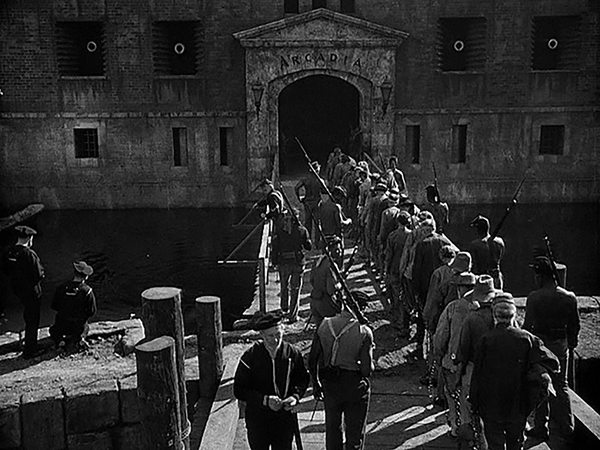
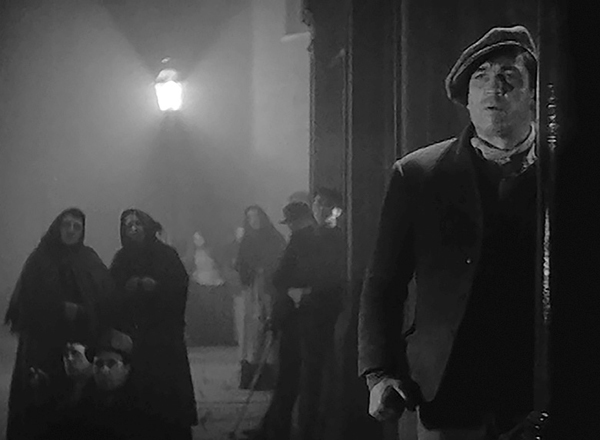
Even more than Underworld, The Docks of New York is a film where almost any shot could yield a dramatic frame enlargement. I’ve made some difficult choices and whittled it down to a few. Let’s just say that it involves a lot of smoke, as in the image immediately below, showing stokers in the engine room of a ship, and a lot of fog, as in the one below it, showing the protagonist’s sidekick looking for him once they’ve gone ashore. Von Sternberg’s well-known predilection for placing elements of the set in the foreground to enhance the composition comes through in both frames. For more fog see the image at the end of this entry.

The film’s story is even simpler than that of Underworld. A Stoker who spends his life at sea with occasional days ashore at various ports save the life of a Girl trying to commit suicide near a seedy dockside tavern. (None of the main characters is given a name.) As she recovers, the pair get to know each other a little. She is presumably a prostitute, he a drifter with, as his tattoos show, a girl in every port. He offers to marry the Girl, and the ceremony takes place in the bar to the amusement of the drunken crowd looking on. The Girl is filled with hope, but the Stoker heads out to sea the next morning. Will he change his mind, or will she despair and successfully drown herself on the next attempt?

The film’s power comes in part through the establishment of the setting: the foggy dock, the rowdy interior of the tavern, and the Girl’s spartan bedroom upstairs, with gulls coming and going on the roof outside the window. Colorful minor characters cluster around the main couple, but they have novital part to play in the drama. The story is compelling largely because of the two leads, especially Betty Compson as the Girl, caught between despair and a reluctant yielding to hope as the kindly Stoker seems to offer her love and relative respectability. Compson had been in films since the mid-1910s, and by the time she retired had made over 200 films. If you’ve seen one of her other films, it’s probably Hitchcock’s Mr. and Mrs. Smith. She played many second female leads in unmemorable films. Yet here von Sternberg guided her to one of the great performances of the silent era. Bancroft is also excellent, though he has the decency not to upstage his co-star. Get out your handkerchiefs for the ending.

In addition to the Bergstrom documentary, there’s a parallel one with Tag Gallagher narrating. Both around 35 minutes long. As a survey of von Sternberg’s silent career, Bergstrom’s is better. Gallagher covers some of the same ground, but he also briefly analyzes the visual style of the films, which might be useful for teachers in preparing a class to watch any of the three films. The Swedish TV documentary also lasts about 35 minutes and covers von Sternberg’s entire career; as is so often the case, the host does not ask the right questions. Despite his reputation for being “difficult” as a director, von Sternberg comes across as quietly charming and modest. The booklet contains program notes by Geoffrey O’Brien, Anton Kaes, and Luc Sante, as well as Hecht’s original short story and information on the musical tracks.

Now if only someone would bring out Thunderbolt on DVD. When I was a newly minted Ph.D. graduate, I taught a survey history course that included Thunderbolt as my example of early sound. Not exactly typical, but Eisenstein and Pudovkin surely would have loved its sound counterpoint, with an offscreen prison jazz group striking up a tune at unexpected moments during the second half.

[Added August 24: Robert Israel has written an informative account of composing the accompaniment for The Docks of New York; it's posted on Nitrateville. Thanks to Evan Davis for the link.]

Where Roxie Hart got her start

A reporter sets up a dramatic photo of Roxie in Chicago

Last month the folks at Flicker Alley released a restoration of the 1927 film Chicago. It’s the story of Roxie Hart, more familiar from the 1942 Ginger Rogers version, Roxie Hart, and the 2002 musical Chicago. It was signed by director Frank Urson, although tradition has it that Cecil B. De Mille, credited as producer, really directed. The explanation given is that he felt it would hurt his new-found reputation as an upright maker of biblical epics reacently earned with King of Kings (1926).

There’s no decisive proof that De Mille did actually direct Chicago, but film historian Robert S. Birchard musters the evidence in his note “Who Directed Chicago?” in the accompanying booklet.

Chicago is no masterpiece, but it boasts a n entertaining plot and is certainly a polished film, showing off the classical Hollywood style in its mature, late 1920s phase. The continuity is expert, complete with point-of-view shots, short/reverse shot, cutaways. The three-point lighting system is everywhere, giving characters a little glowing outline that at once makes dark figures stand out against dark backgrounds and creates an aura of glamor for the ladies (even in a prison scene.)

The film also contains a technique that Hollywood filmmakers were getting quite good at: significant motifs. There’s a player piano in Roxie’s apartment that comes briefly into the plot numerous times. There are the garters with little bells attached that economically convey first to us and later to Roxie’s husband that she’s having an affair. There are mirrors and watches and, above all ,newspapers.

Given that Underworld and this film were both made in 1927 and set in Chicago, it would be interesting to show them on a double feature. They would probably surprise those people who still consider silent films crude and jerky. Von Sternberg’s film shows how brilliantly and beautifully a story could be told just before sound came in. Chicago, though no masterpiece, would show how good even an ordinary film could be.

The restoration was made from a well-preserved nitrate print in De Mille’s own collection, and it looks great. Most of the extras, both on the second disc and in the booklet, deal with the criminal case on which the various versions are based. It’s an interesting tale, since Maurine Watkins, who wrote the original 1926 play of the same name, started out as a journalist who sensationalized real-life murder cases in order to further her own career. Her treatment of money-grubbing, opportunistic reporters in effect satirizes herself. She kept secret her life as a journalist, but she was unable to duplicate her success as a playwright and ended up a minor scriptwriter in Hollywood.

Other supplements cover flappers and the 1920s jazz age, but there is little on the film itself.

The Docks of New York

Revisiting INCEPTION

Thursday | August 12, 2010

Inception.

Heading cross-country from Chicago in Dad’s old Honda Prelude, we’re no further than Wisconsin on the first day when Jonah turns from the passenger seat and tells me he’s working on something.

Christopher Nolan, on the origins of Memento

We were driving my dad’s old car from Chicago to Los Angeles. It must have been the second day of driving–we were past Minnesota.

Jonathan Nolan, on the origins of Memento

It’s rare when a filmmaker confirms hypotheses put forward by critics. But that seems to have happened to us.

An enormous amount had been written about Inception, both on the internet and in print, before we wrote our blog entry last week. For the most part, we avoided reading about the film, fearing spoilers and statements about the film that might influence our own initial take on it. Since then, we’ve read Jeff Goldsmith’s in-depth interview with Christopher Nolan published in Creative Screenwriting (not yet available online). There Nolan broaches several ideas about his approach to the film, and some of those square with our analysis. Today we highlight a few of those remarks and tease out their implications. We end with comments from some readers.

Exposition rules

Kristin here:

My contribution to last week’s entry concerned the film’s dependence on nearly continuous exposition, which I thought of as a major formal device across the film. In the Creative Screenwriter interview, Nolan says that exposition was a particular concern of his in making the film.

Ten years ago he envisioned the film as a heist caper:

“One of the fascinating things about the heist movie, and one of the reasons I took this as the model, is that the type of exposition that in most films is problematic, boring, tricky, hard to get through—in a heist movie becomes the meat of it,” Nolan says. “It’s part of the entertainment simply because the process of a heist movie and that sort of procedure, the way they put things together, becomes the reason you’re watching the story.”

Usually in a heist film we get a big dose of exposition as the team’s leader explains the plans for the crime to his colleagues. Then we watch the plan unfold, with exposition added well into the film as needed. In Inception, however, the heist explanation becomes nearly continuous. Goldsmith comments, “Nolan smartly flipped this conceit on its head and instead of keeping the audience at a distance, he decided to take them along for the entire ride. The subtle re-configuration allows for the audience and the characters to sweat together whenever any hiccups arise in the well-thought-out plan.” In fact, the “well-thought-plan” unfolds only as we watch the film.

Nolan also comments on this idea of the audience being active, saying that he wanted to involve viewers alongside the characters:

“Exposition is such a massive demand,” he admits.” It’s something you have to just try and imbue in the relationships of the characters. You never want to find yourself in a scene where characters are passively receiving information in some way, because you don’t want the audience passively receiving information. You want them engaged with that dramatization.”

The implication here is that the audience becomes involved in the plot not through learning about the characters’ backgrounds and traits, as most spectators seem to expect in standard Hollywood films—even blockbusters. Instead, our relationships with the characters (apart from Cobb) come through learning new information along with them and being attached so closely to them while they work through the mechanics of the plot.

The result, at least for many viewers, seems to be a feeling of dissatisfaction at not being able to get close to the characters in a more conventional, detailed way. The advantage, if one wishes to consider it as such, is that we are forced into a struggle to understand the workings of the plot.

Yet we are not entirely with the characters in their achievement of the mission, because we move back and forth among the levels of the dream, as none of them does. Thus we may be attached to the characters in the parceling-out of exposition, but we know much more than they do at any given moment once the second dream (the hotel) begins. The result comes through further experimentation on Nolan’s part, this time with intercutting.

Prestigious patterning

The Prestige.

DB here:

In our earlier entry I argued that Inception uses the dream subject matter to set up a heist plot and to motivate a pattern of embedded narratives. Normally, embedded stories are presented as sealed off from one another, like concentric circles. One interest of the film, I thought, lies in the freedom with which Nolan crosscut among these nested tales.

After further reading and re-viewing, I’m forced to ask: Which is the real center of his interest–embedded stories or crosscutting? And this question leads me to think about his development as a filmic storyteller.

In college Nolan studied literature (a good model for aspiring filmmakers, who too often focus only on movies). To this training he attributes his interest in form. “I wrote Memento very much as a puzzle box. I was fascinated by the idea of structure.”

For Nolan, I think, form has centrally to do with the sorts of juxtapositions you can create by crosscutting. You could say he treats crosscutting the way Ophuls treats tracking shots or Dreyer treats stark decor: an initial commitment to a creative choice, which in turn shapes the handling of story, staging, performance and other factors.

Moreover, his fondness for crosscutting favors actions taking place in different time frames. Traditionally, a crosscut sequence switches between lines of action taking place at the same time. While Smith walks his dog, we see Jones stalking Smith’s wife. The Dark Knight has many sequences that crosscut simultaneous lines of action. When crosscutting isn’t presenting simultaneous actions, it’s often alternating between present and past. An influential example is Hiroshima mon amour, in which the female protagonist’s memories of occupied France are juxtaposed with her visit to Hiroshima in the present. Here, as often happens, the switch to an earlier time is motivated as a character-based flashback, an expression of the persistence of her memories.

Nolan’s interest in crosscutting various time frames doesn’t quite square with tradition. He was much influenced by Graham Swift’s 1983 novel Waterland, as he has pointed out over the years. Here is what he says in the CS interview.

“It opened my eyes to something I found absolutely shocking at the time,” Nolan says. “It’s structured with a set of parallel timelines and effortlessly tells a story using history—a contemporary story and various timelines that were close together in time (recent past and less recent past), and it actually cross cuts these timelines with such ease that, by the end, he’s literally sort of leaving sentences unfinished and you’re filling in the gaps.”

What initially intrigued Nolan, it seems to me, is the idea of taking a story that could be told in straightforward chronology and breaking it into two or three discrete phases. He then cuts among scenes within the phases, without motivating the shifts as character-centered flashbacks.

The story of his first feature, Following, could have been told in 1-2-3 order. Instead, within a framing situation of an interrogation, the plot breaks the protagonist’s tale into three phases, all quite close in time, and then cuts among them. Within each phase, the action is chronological (so far as I can see), but the three “eras” are intercut. Nolan is careful to keep us oriented as to which time zone we’re in through things like the protagonist’s appearance (sloppy, well-groomed, bruised) and a burst of black frames that signals a shift to a different zone. Eventually all three phases get linked up, so, for example, the last thing we see of phase one leads smoothly to what we saw as the first imagery of phase two.

The same concern to break up a linear story is at work in Memento. Again, different phases of the same tale are intercut. But now a forward-moving module is accompanied by one moving backward. Again, these are kept distinct through time markers (color footage vs. black-and-white), and the reverse-chronology one is filled with tokens and echoes that remind us that what we’ve already seen actually took place after what we’re seeing now.

The Prestige expands crosscutting in another direction. Christopher Priest’s original novel is based on the discovered-manuscript convention. Adam Worthy, a publisher, begins reading a book by Alfred Borden, Secret Methods of Magic. What follows are several other memoirs, treating events at different points in history, with some going back as far as 1866. These texts are not intercut or even nested. They stand as solid blocks, presenting overlapping time schemes and varying points of view on the central rivalry between the two conjurers Borden and Robert Angier.

For the film of The Prestige Nolan and his screenwriter-brother Jonathan again create a basically linear chronology. Once more it is fractured into discrete phases. There is a present (Cutter showing a bird trick to the little girl Jess), the recent past (Alfred arrested for killing Robert and awaiting trial), a more distant past (Robert visiting Nicolai Tesla in Colorado), and thanks to Alfred’s journal, the most remote days when the two became competitors and Alfred created the Transported Man illusion.

But The Prestige treats its time zones somewhat as if they were embedded stories. I think that this is partly because we have two protagonists and a split point-of-view pattern. The biggest cue, however, is the way that the Nolans absorb the discovered-manuscript convention into the film. In a classic embedded structure, a character recalls or recounts a string of events with its own integrity, and sometimes the frame story involves a character reading a letter or memoir. In the film, this situation is provided by journals kept by the rival magicians. Now Nolan can cut freely among nested stories. At one point we have Alfred, jailed for murder, reading Robert’s journal, in which Robert tells about reading Alfred’s journal in Colorado. Alfred’s version of events is embedded in Robert’s version, which is in turn embedded in the moment of Alfred’s reading in prison.

Moreover, instead of Following’s rather mechanical demarcation of phases (black frames signal a shift between phases), the narration of The Prestige is quite fluid, joining distant periods through smooth hooks of imagery and sound. Sometimes the sound comes from one period but the shots are in a distant one. We’re introduced to this strategy in the very opening: Cutter’s voice-over is in the present, but the image is two layers into the past.

So it seems to me that in The Prestige Nolan’s interest in crosscutting different timelines became more audacious, working with not only linear events but embedded stories. The interest in nested stories emerges much more explicitly in Inception, as I suggested in the earlier post. But what I didn’t see then was that using dreams to motivate embedded plotlines changes the time game.

A dream within a dream can’t be said to be taking place earlier than the surrounding dream, the way a flashback or discovered manuscript necessarily presents past events. The dream realms can’t be ironed out into a chronological structure as the phased plotlines of Following, Memento, and The Prestige can. In fact we find our old friend simultaneity at work among all the phases (dreaming while dreaming while, etc.). And Nolan’s film invokes the convention of the climactic deadline (actually, four of them). So in a perverse way, Inception’s formal gambit is more traditional than the time-scrambling of the earlier films. But because we seldom see embedded stories intercut, the result is also pretty daring–something akin to that abstract filmic time that Griffith creates by intercutting four historical epochs in Intolerance.

From this perspective, Inception marks a step forward in Nolan’s exploration of telling a story by crosscutting different time frames. You can even measure the changes quantitatively. Following contains four timelines and intercuts (for the most part) three. Memento intercuts two timelines, but one moves backward. Like FollowingThe Prestige contains four timelines and intercuts three, but it opens the way toward intercutting embedded stories. The climax of Inception intercuts four embedded timelines, all of them framed by a fifth, the plane trip in the present. For reasons I mentioned in the previous post, it’s possible that Nolan has hit a recursive limit. Any more timelines and most viewers will get lost. What can he do next?

Letters, we get letters (and links)

DB again:

We’re grateful to several people who linked to our posting, especially Jim Emerson at Scanners, who continues to compile ideas about a movie he doesn’t like much. Other people wrote us directly to share some ideas. From Jason Mittell of Middlebury College:

I really appreciate and agree with the idea that the motivation for the film is to tell nested or embedded stories, with the shared dreaming device essentially as a framing convenience rather than thematic imperative. One parallel I was surprised D&K didn’t raise was with the embedded narration of The Prestige. I teach the latter in my narrative theory course as a case study specifically to explore how the film plays with storytelling levels, with the dual journals/letters, voice-over, flashbacks, etc. Inception makes this layering more literal in terms of parallel worlds, but I do see some important precedents forged in Nolan’s earlier work.

I agree with Jason’s suggestion about The Prestige and decided to develop the point he suggested. I didn’t dwell on the film in the earlier entry beyond noting that it’s discussed at some length it in the ninth edition of Film Art: An Introduction. It’s good to know that Jason (who maintains an excellent blog here) finds the film a lively way to introduce narrative concepts in his teaching.

Jim Healy pointed out another example of a film with several nested story lines.

As for complicated embeddings since The Matrix, I was a big fan (maybe the only one) of Carpenter’s Ghosts of Mars, which has, I think, a flashback within a flashback, within a flashback, within a flashback.

James Kreul wrote with another example of nested-goal crosscutting schemes:

You might consider looking at Matthew Barney’s Cremaster 3, or at least the segment available on DVD called “The Order.”  “The Order” has simultaneous action on 5 different levels of the Guggenheim Museum.  If you watch it linearly, it seems very much like a video game, as the protagonist has to achieve certain goals on each level.  The DVD also gives you the option, however, of toggling between the different levels across the duration of the segment, so that even if the protagonist isn’t on level 1, you can watch level 1 (there was a variation on this for the multiple-screen video installation version of the piece).

“The Order” itself is nested within the larger narrative of the protagonist (Barney, the “Entered Apprentice”) working his way up the Chrysler Building to confront “the Architect,” and there is a parallel between the climax of the Order and the climax of the action with the architect. The website synopsis describes “The Order” as a “choric interlude,” and even though the Barney character is called the Entered Apprentice in the both the larger and nested narrative, the nested version is a “fantastical incarnation” of the character. But there’s nothing to mark it explicitly as a dream or the subjective experience of the character (as far as I can remember). The two versions of the character are instead connected by the fact that Barney plays both of them and by certain motifs (he loses teeth in the larger narrative, he has a bloody mouth in “The Order”).

In any case, it might be a useful example if you return to the idea of narrative strategies within a nested structure. “The Order” also has various thematic connections with the other films in the series (each level in the Guggenheim references the 5 films in the series) so that this “middle film” both looks back and looks forward to the other films in the series. It was released last.

Jim’s reference to Barney’s Cremaster series reinforces our sense that Nolan is exploring some avant-garde techniques but anchoring them in familiar genres, plot patterns, and the like. Motivation, in other words.

Speaking of motivation, I wrote in an aside in the original post: “Likewise, the backward progression of Memento’s plot is partly justified by the clinical condition of short-term memory deficits. I grant you, why this ailment supports a reverse-chronology tale is a bit puzzling.” In reply David Wigram wrote to point out that most movies want to align the viewer with the protagonist’s thoughts and feelings. Accordingly,

In Memento Nolan needs to keep the audience as clueless about the recent past as Leonard is, otherwise this identification is lost. The only way to do this is with the looping reverse form that was used. All the other aspects of the conceit flow from this necessity. I seem to remember interviews in which Nolan talked about trying to find the technique required to tell this story, and how everything fell into place when he did. But even if it was reverse-engineered, even if the filmmmaker simply wanted to make a fractured-time narrative and needed a story – any story – to tell, I think story and storytelling in Memento (of anterograde amnesia in the protagonist and a looping reversed chronology) are perfectly and elegantly matched.

I find David’s point persuasive. It illustrates how an overarching formal commitment confronts you with a cascade of obligatory choices, and how those choices can be motivated.

If you want to restrict the plot to Leonard’s range of knowledge, you have a problem because he forgets what happened to him a few minutes before. Then our knowledge will always be greater than his, creating a very externalized, objective narration. In other words, if the events are told chronologically, then we see what Leonard will soon forget. But a reverse-order plot suppresses our knowledge of the recent past, thus approximating the character’s range of knowledge in any particular scene.

This creates a new problem to solve, however, because we now still have knowledge outside Leonard’s ken—knowledge of the future story events. For instance, we know that he will be betrayed by Natalie and will shoot Teddy. Yet in a way our future knowledge doesn’t hurt the plot’s unfolding, because this is a film noir. In a noir we often sense that harm is destined to befall the protagonist. This sense of fatality is sometimes specified by a frame story anticipating the protagonist’s end, as in Double Indemnity and Sunset Boulevard. Here, instead of using a flashback, Nolan conjures up the doom scenario by reverse-order presentation. Motivation again, this time by that quasi-genre we call film noir. Would the structure work so well with a Western?

Like Inception, Memento finds a structure that meets Hollywood’s demand that the presentation be motivated by appeal to genre and character psychology. A good counterexample is provided by Gaspar Noë’s Irreversible, in which the 3-2-1 ordering of scenes isn’t justified by such factors. As often happens outside Hollywood, a play with form doesn’t need such motivations–or alibis, if you like.


The Nolan brothers’ memories of Memento are taken from Christopher Nolan, Memento and Following (London: Faber, 2001), p. 233. In the same volume (pp. 97-99), Nolan offers some comments on structure echoing those we quote here. The remarks on Inception come from Jeff Goldsmith, “The Architect of Dreams,” Creative Screenwriting (July/ August 2010), 18-26. CS is well worth subscribing to, and its free podcasts are very informative. On Memento, Andy Klein’s careful reconstruction from 2001 remains admirable. On Christopher Priest’s reaction to the film version of his novel, see The Magic: The Story of a Film; see also our entry here. For a discussion of the sort of audiovisual hooks Nolan employs in The Prestige, see this web essay. Another entry on this site considers Nolan’s visual storytelling in The Prestige. We also have a post discussing Barney’s Cremaster project.

P. S. 31 August: Who can keep up with all the Webchurn on Inception? We won’t try, but simply point you to two reactions that pictorialize the embedded-dream device: here and here.

Scientific American weighs in on lucid dreaming. And again here.

P. S. 2 Sept: Sean Wietner makes this point about how Nolan motivates slow motion:

In an
interview with Elvis Mitchell on his KCRW program The Treatment, Nolan
mentions that he’s had a hard time being comfortable with the
aesthetics of slow motion — he’s never known what it’s best used for.
So he was quite chuffed about the falling van in Inception — finally,
a good reason to use slow-motion. He makes similar comments about
cross-cutting that echo your blog post; he’s so pleased to be “forced
by” (my paraphrase) the narrative to cut parallel action like this.

This is one of the things about Nolan that sticks with me, and I think
it’s related to the perception some have of him as chilly. I think it
speaks to a larger issue that touches on ideas like Hitchcock’s
plausibles, and their Body Snatcher infiltration of audience mores.
There are times when Nolan comes across as the King of the Plausibles,
the overplanner who can’t deal with being painted into a corner, so
rather than deal with that messiness he erects massive scaffolding. He
requires a time-dilation mechanic so he can have the freedom to play
with the classic cinematic device of slow motion!

Thanks to Sean for his comment.

David Bordwell
top of page

comments about the state of this website go to Meg Hamel.

hosted by www.topped-with-meat.com